
I have thoroughly enjoyed studying Digital Business Models this term. The module is unique in that it is almost exclusively taught online. Moreover, the week-by-week subject content covers a range of topics that are both useful and relevant for society, business and the workplace going forward.

The first couple of weeks saw our learning temporarily shifted onto a popular MOOC platform, Future Learn. The site’s smooth and intuitive interface enhanced usability and accessibility, while its comment sections enabled lively and thought-provoking discussions to be had. The topics covered related to the future of work featuring trends such as AI, machine learning, amplified individuals, and much more. It was fascinating and enlightening to read and understand the opinions of others on these issues.
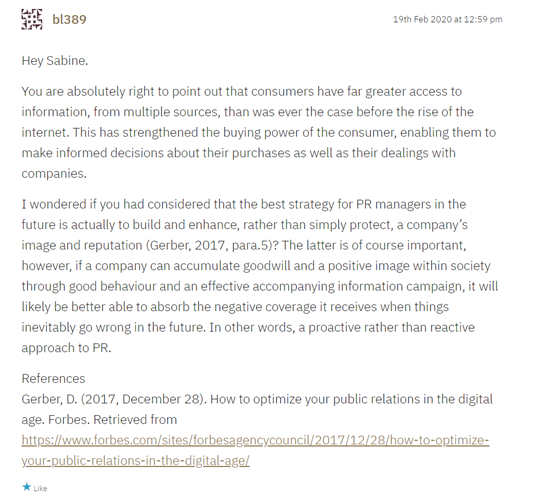
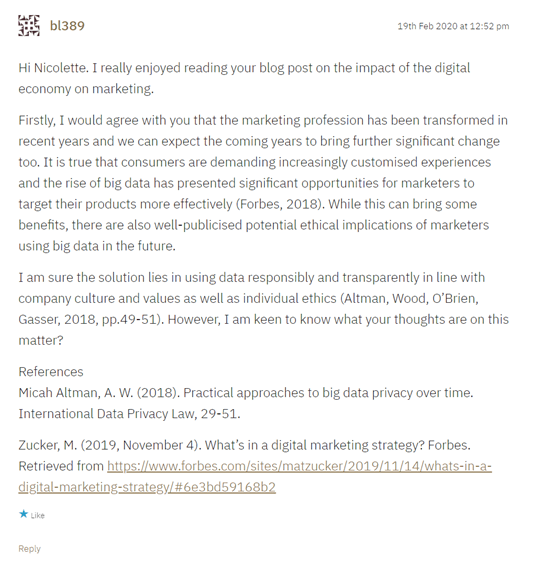
The future of work was also the topic of our first assessed blogpost where we had to assess the impact of the digital economy on a chosen job role. I selected the retail banker. I explored the blogs of my peers and commented on Sabine’s PR & Communications blog as well as Nicolette’s one on Marketing (see below).
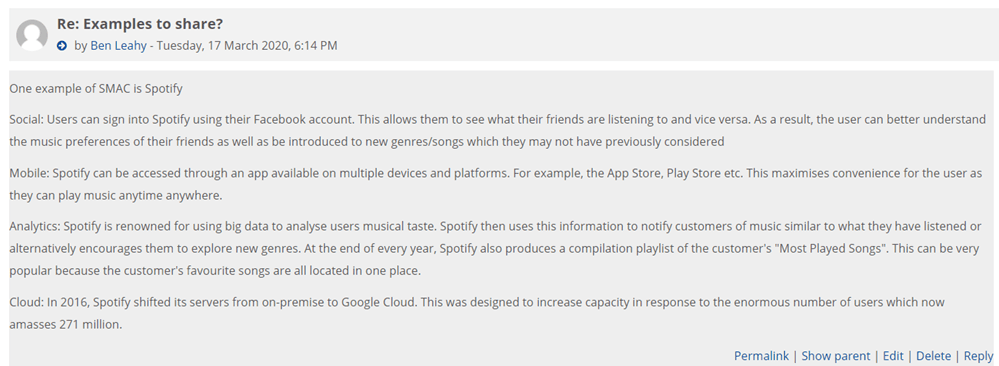
Midway through the term, the module examined the rise of the “sharing” and “circular” economies, new business models, and the impact of digital disruption. From individual study and reviewing comments, I acquired a proper understanding of the theory behind “sharing” and “circular” economies as well as the concomitant fantastic business opportunities. With regards to new business models, I contributed Spotify as a business which makes use of SMAC.
However, it was only by reading the examples of companies, posted by my peers, that I realised how pervasive and disruptive these latest technologies are.
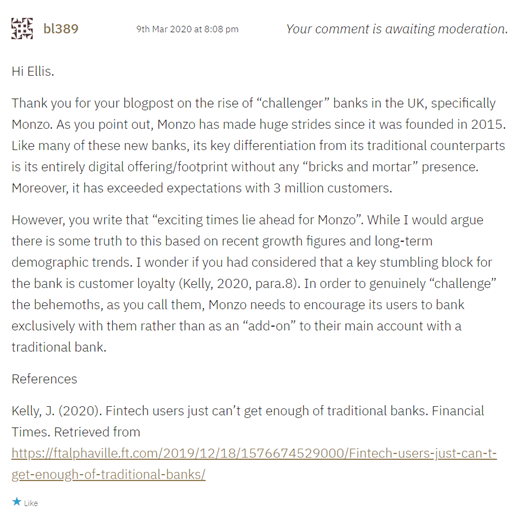
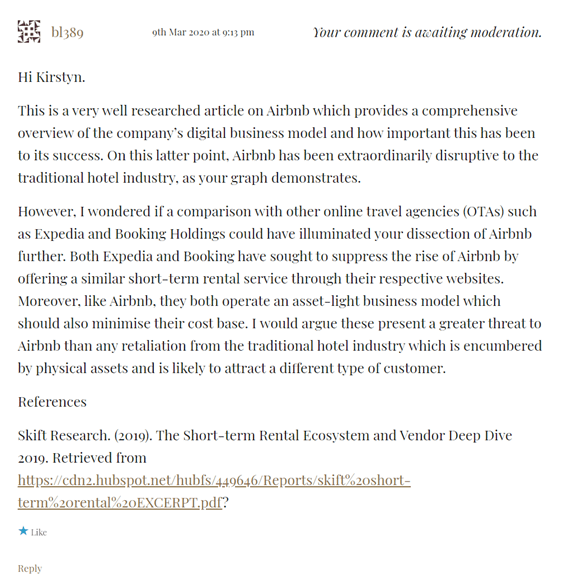
Our second assessed blogpost built on this and required us to critique the digital business model of a chosen company. I opted for Amazon whose business is almost exclusively online and has experienced phenomenal growth as a result. I found Ellis’s blog on “challenger” banks particularly interesting as well as Kirstyn’s on the rise of Airbnb and so, decided to comment on both (see below).
Towards the end of the module, we explored “Ethical Issues in the Digital World”. I think this is an important, but often neglected, topic which I raised in my comments on ELE:
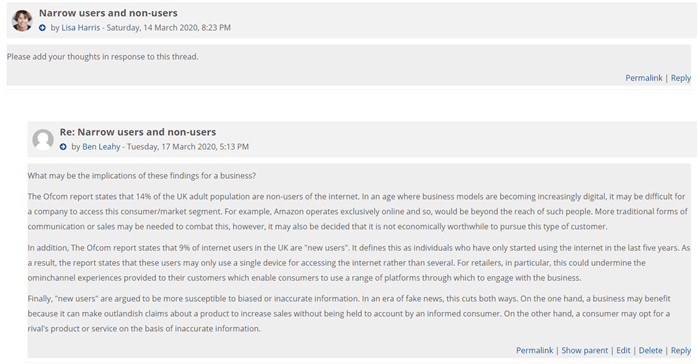
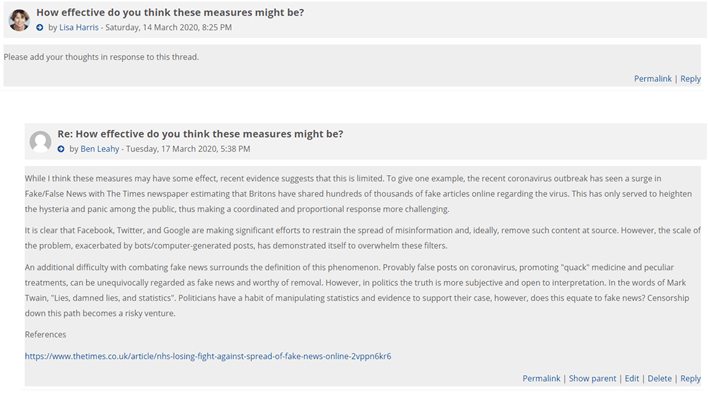
It was good to read the thoughts of others on internet access inequalities and the rise of fake news as well as strategies to tackle these. The latter was particularly pertinent given the wave of disinformation online surrounding the current coronavirus pandemic.
Overall, reading, commenting, and participating in weekly module discussions has enriched my learning by providing differences in insight, perspective, and experience not typically gained through traditional classroom-style teaching.
440 words
What will I take forward from this module?
 Ben Leahy | MSc International Management