The career path I have chosen for exploring the impact of the digital economy is retail banking. It is just over 30 years ago that First Direct (now part of HSBC) was launched as the UK’s first branchless bank. Its telephone-based customer service was designed to appeal to busy professionals but also began a change in the front line of retail banking. Now, the impact of digital disruption is transforming the consumer banking experience again. Omni-channel interaction is driving change for banks on the high street in a very similar way to the entire retail sector. So much so that a recent survey carried out by Accenture (2017, part 1, p.10) found that nearly 50% of consumers believe that traditional banks may not be necessary in the future. This figure is reinforced by the fact that nearly half of UK adults used mobile banking in 2018 in some way or other. Stephen Jones, CEO of UK Finance opined that “more and more customers are now opting for speed and convenience” (UK Finance, 2019, para.5).
The retail banking business model is having to adapt rapidly and this means the role of the front line retail banker is changing.
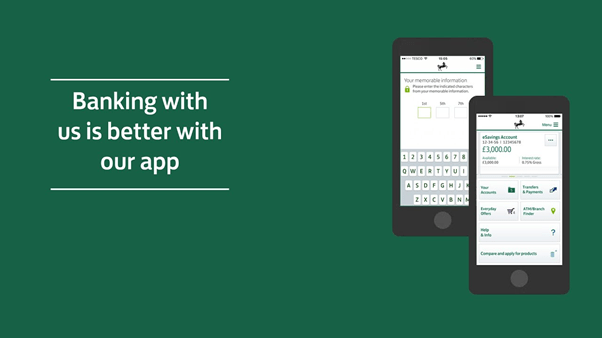
In terms of customer engagement, banks are becoming increasingly digitized. The network of branches across the country is shrinking fast with as many as 3,372 closures in the last four years (Briefing Paper, 2020, para.8). This is a pragmatic response to changing consumer demand which can be increasingly satisfied online. For instance, the emergence of internet banking available through an app on your digital device. Money transfers can be completed at the touch of a button, while I can pay in a cheque by simply taking a photo on my phone, whereas ten years ago my parents stood in the traditional lunch-time bank queue to engage with a bank teller to achieve the same outcome.
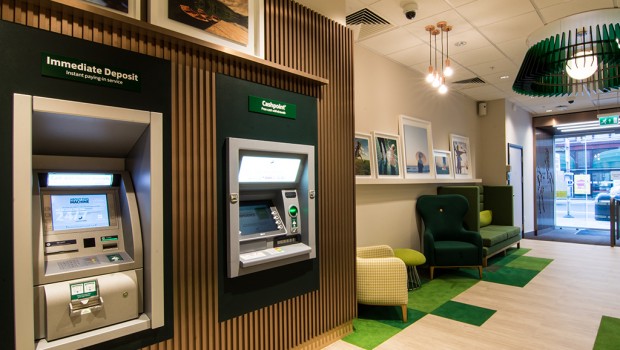
While this maximises convenience for the customer and builds a sustainable consumer engagement platform, retail bankers are not having as many of the traditional face-to-face customer interactions of the past. Instead, the vast majority of interactions are increasingly self-serviced using digital solutions. The retail banker was already undergoing change from the traditional, transactional teller function towards trying to promote the bank’s services more actively. However, this is not always easy to do when there is a long queue building up. This has now changed with branches increasingly being remodelled to remove teller counters completely and replace them with fully integrated self-service machines, supported by “floating” customer advisers. These advisers have a very different role and skill set. They both train the non tech savvy, often older customer in how to use the self-service machines but are also sales professionals with the highest levels of training in the bank’s products. As customers become more comfortable with using self-service machines and online banking, the in-branch adviser roles will increasingly focus more on sales. Branches will therefore have fewer staff and with different skill sets.
Having a personal presence is important for the traditional high street banks. Despite the emergence of new challenger banks in the sector, such as Monzo, Metro, Atom Bank etc, the market shares of the legacy banks have held up surprisingly well. There appears to be a residual loyalty and trust. It is therefore imperative that they continue to earn this trust through high levels of customer service and technological capability and convenience. However, this can be challenging as the major banks still have to wrestle with upgrades to their legacy systems and services outages as notably occurred with RBS and TSB in 2019 can be reputationally damaging.
There is a high demand for self-service by consumers today until it fails. AI powered chat bots are a useful way of dealing with basic banking problems (PWC, 2020, para.1). However, the personal touch still has a place in the retail banking environment especially where complexity is involved.
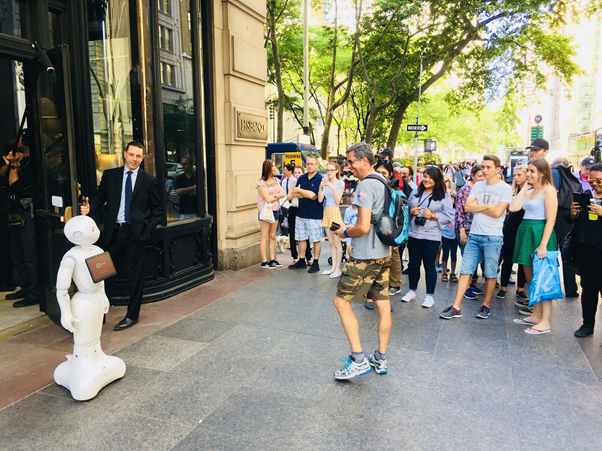
One interesting development last year was the introduction by HSBC of a 4 feet tall cute robot with a tablet attached to its chest which patrolled outside its 5th Avenue Manhattan branch. The purpose was to lure people into the branch, answer basic banking questions but also lead to higher value customer engagements for the in-branch advisers.
In terms providing and training a workforce to perform at this new level, the banks have demonstrated a serious commitment to lifelong learning, acknowledging the benefits of developing the ‘amplified individual’. For example, it has become imperative for workers to “have the ability to maintain and renew the right skills through lifelong learning” (UK Government, 2017, part 1, p.6). Recognising this, PayPal recently started to offer on-demand, self-directed video learning to its employees. Consequently, in line with Ernest Wilson’s “third space thinking” (2016, p.1), retail bankers are showing initiative and taking ownership of their personal and career development.
In conclusion, AI is here to stay and it provides opportunities all round. For the customer, transactions can be done more quickly on-line or in branch, whilst human interaction remains available in branch; for banks it allows for a more profitable model without compromising customer service (deSouza, 2014, p.1); and for retail bankers, their roles become more skilled and fulfilling.

References
Accenture. (2017). Winning in the Digital Economy. Retrieved from https://www.accenture.com/_acnmedia/pdf-45/accenture-banking-winning-in-the-digital-economy-executive-summary.pdf
Accenture. (2019). Accenture Technology Vision 2019. Retrieved from https://www.accenture.com/_acnmedia/PDF-94/Accenture-TechVision-2019-Tech-Trends-Report.pdf#zoom=50
Deloitte. (2019). Deloitte Human Capital Trends Survey 2019. Retrieved from https://www2.deloitte.com/content/dam/Deloitte/cz/Documents/human-capital/cz-hc-trends-reinvent-with-human-focus.pdf
deSouza, D. (2014, March 24). How-to guide: social enterprises and managing motivation. The Guardian. p.1
EY. (2018). The New Age: Artificial Intelligence for Human Resource Opportunities and Functions. Retrieved from https://www.ey.com/Publication/vwLUAssets/EY-the-new-age-artificial-intelligence-for-human-resource-opportunities-and-functions/$FILE/EY-the-new-age-artificial-intelligence-for-human-resource-opportunities-and-functions.pdf
Gorbis, M. (2013). The New Kind of Worker Every Business Needs. Harvard Business Review, (April), 1-5.
House of Commons – Briefing Paper: Bank branches: why are they closing and what is the impact? (HC (2020) CBP 8740). London: TSO
PWC. (2020). Chatbot: The intelligent banking assistant. Retrieved February 12, 2020 from https://www.pwc.in/consulting/financial-services/fintech/fintech-insights/chatbot-the-intelligent-banking-assistant.html
UK Finance. (2019). Rise in mobile banking and contactless as consumers take pick ‘n’ mix approach to payments. Retrieved February 12, 2020 from https://www.ukfinance.org.uk/press/press-releases/rise-mobile-banking-and-contactless-consumers-take-pick-n-mix-approach-payments
UK Government. (2017). Future of Skills and Lifelong Learning. Retrieved from https://assets.publishing.service.gov.uk/government/uploads/system/uploads/attachment_data/file/727776/Foresight-future-of-skills-lifelong-learning_V8.pdf
Wilson, E. (2016, November 25). Why Startup Leaders Need to Use ‘Third Space Thinking’. Inc., p.1
 Ben Leahy | MSc International Management