
Amazon’s digital business model has been instrumental to its success. Founded in 1994, Amazon has transformed from a marketplace for books into an internet giant. Its size has led to it being referred to as “one of the most influential economic and cultural forces in the world” (Jacoby, 2020). On its journey to achieving this remarkable growth and success, Amazon overhauled business models becoming an early adopter of an asset light, online alternative (Li, 2018, p.4). Its marketplace is exclusively online, known as e-commerce, and has since diversified into a range of goods far exceeding its original remit of a book-seller. More recently, in line with SMAC, Amazon has branched into cloud computing and digital streaming, and even the next level of digital transformation with artificial intelligence (Olenski, 2016, para.2). This blog will break down the key features of the company’s digital business model and explain how these have been so effective.
Online Shopping
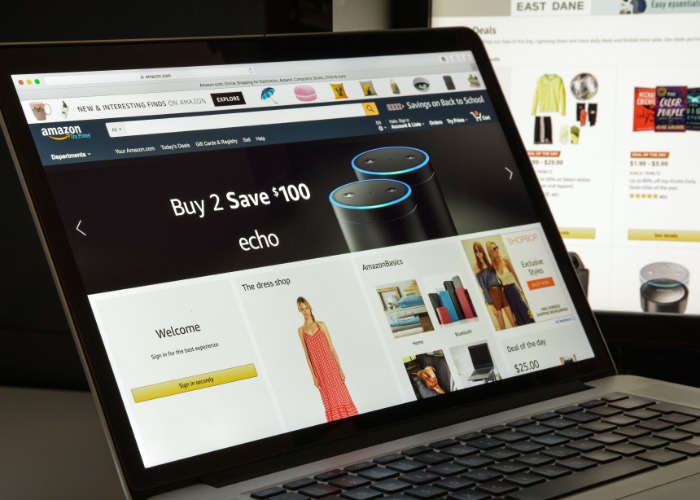
Only Alibaba, its Chinese counterpart, can compete with Amazon in the scale and breadth of its online offering. Being online means the company completes all its sales and transactions through its website “Amazon.com” and does not own any “bricks and mortar” storefronts traditionally associated with major High Street names (Gray, 2019, para.2). Importantly for Amazon’s competitive advantage, this is how the company has functioned since its foundation. By contrast, other retailers have only made the shift towards online stores in the last 10 years. Therefore, not only has Amazon been leading the way in terms of consumer convenience from the very start, but it has also been able to undercut the prices of its competitors. This is because the company is not saddled with the overheads and labour costs which weigh on its rivals (Van Tulder, 2018, p.19). When online convenience, a diversified product range, and low prices are combined, a very appealing service is created.
Business Ecosystem
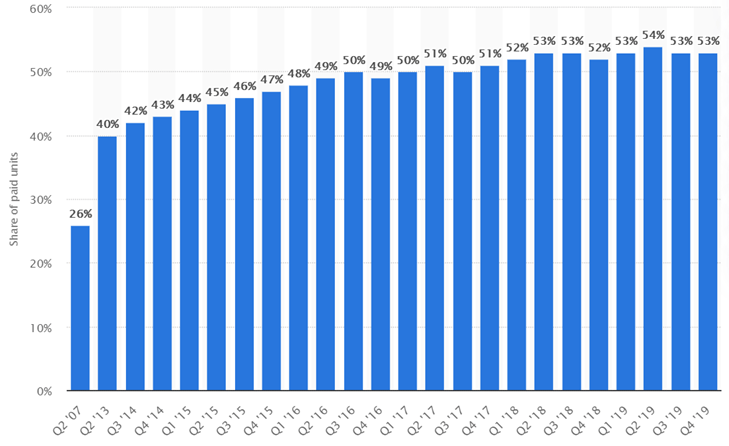
In addition to its direct sales, Amazon has also created a platform which allows for approved third party retailers to sell products to buyers. Amazon then takes a share of the sales price as commission. This is mutually beneficial for both parties as Amazon can avoid holding slow-moving inventory which may impact profits, while the third-party can increase their sales courtesy of the greater visibility and respectability conferred through Amazon’s brand image and search-engine-optimisation (SEO). This latter technological feature provides Amazon with powerful leverage with its supplier relationships. Evidence suggests this arrangement is becoming increasingly successful with the proportion of sales which third parties comprise soaring from a mere 3% in 1999 to as much as 53% today (Statista, 2019, para.1). This extra business and profitability is generated without any incremental cost or capital from Amazon.
Despite managing an open ecosystem, Amazon does also operate a ‘closed’ platform in some areas. This refers to a company selling the customer an interdependent suite of products (Sherr & Totty, 2011, para.2). For example, a consumer may purchase a Kindle, however, they can only buy books from the Kindle Store. Equally, a consumer may appreciate the voice-functionality of an Alexa to play music, however, they are confined to Amazon Music. This technique is not unique with Apple utilising the App Store for its devices and Google with the Play Store.

Subscription-based model
One of the common digital business models operated by companies is the subscription-based model and Amazon is no exception. Amazon Prime requires a monthly payment of £7.99 and in return provides you with next-day delivery for online orders, access to a wide variety of video and music streaming content, and a rotating selection of e-books for your Kindle. In an era of instant gratification, consumers increasingly want their purchases now and Amazon Prime does this. With over 150 million subscribers worldwide and revenue of over $15bn, Amazon’s subscription-based model has been a resounding success (Reisinger, 2020, para.5).
Freemium model
Freemium is a portmanteau of “free” and “premium”. While this may sound counter-intuitive, the term refers to the limited access a user will be given by a company to a subscription-based product or service. One example is this blogging platform WordPress which offers customers a basic version of its service with the option of upgrading to receive better features and capabilities. As a business technique, this is designed to give the consumer a flavour of a product/service with the ultimate goal of encouraging them to pay for the “premium” version. Amazon operates this model with regards to its music-streaming service. Prime gives the customer access to a selection of songs, however, an additional monthly fee is required to become “Unlimited”. Testament to its success, Amazon Music Unlimited now has 55 million subscribers putting it neck-and-neck with one of its major rivals, Apple (Bera, 2020, para.1).

Conclusion
Amazon has made extraordinarily effective use of its digital business model, expanding into a myriad of industries, increasing its customer base, and disrupting established companies. Its reputation for convenience, best-in-class delivery and putting the customer first has been indispensable to this. Its digital disruption and success, putting customer service ahead of profitability, has resulted in a global market share for its platform model way beyond what was thought possible (Amazon, 2020, para.5).
880 words
References
Amazon (2020). Amazon.com announces fourth-quarter sales up 21% to $87.4bn. Retrieved March 3, 2020 from https://ir.aboutamazon.com/news-releases/news-release-details/amazoncom-announces-fourth-quarter-sales-21-874-billion
Bera, A. (2020, January 22). Amazon Music crosses 55 million subscribers globally. Reuters. Retrieved from https://www.reuters.com/article/us-amazon-music/amazon-music-crosses-55-million-subscribers-globally-trails-apple-music-idUSKBN1ZL2GE
Gray, A. (2019, January 21). Can tech save bricks and mortar retail? Financial Times. Retrieved from https://www.ft.com/content/69c25116-1ac1-11e9-9e64-d150b3105d21
Holt, K. (2019, February 11). Alexa and Amazon Music. Engadget. Retrieved from https://www.engadget.com/2018/11/02/alexa-amazon-music-notifications/
Jacoby, J. (Producer). (2020). Amazon Empire: The Rise and Reign of Jeff Bezos [Television Programme]. Boston: PBS Frontline
Li, F. (2018). The digital transformation of business models in the creative industries: A holistic framework and emerging trends. Technovation, 1-10. Retrieved from https://www.sciencedirect.com/science/article/pii/S0166497217300536?via%3Dihub
LoveMoney Staff (2019, March 19). How to save money when shopping at Amazon. LoveMoney. Retrieved from https://www.lovemoney.com/news/49130/ways-to-save-money-shopping-at-amazon
Olenski, S. (2016, May 26). Why Marketers need a SMAC. Forbes. Retrieved from https://www.forbes.com/sites/steveolenski/2016/05/26/why-marketers-need-a-smac/#33058dfa6a3d
Quarton, S. (2019, September 7). Pros and Cons of the Freemium Business Model. Pro Plugin Directory. Retrieved from https://proplugindirectory.com/freemium-wordpress-plugin-business-model/
Reisinger, D. (2020, January 17). Amazon Prime’s numbers and influence continue to grow. Fortune. Retrieved from https://fortune.com/2020/01/16/amazon-prime-subscriptions/
Sherr, I, and Totty, M. (2011, November 15). Is it better for businesses to adopt open or closed platforms? The Wall Street Journal. Retrieved from https://www.wsj.com/articles/SB10001424052970204554204577023994194742720
Statista (2020). Amazon Third Party Sales 2007-2019. Retrieved March 3, 2020 from https://www.statista.com/statistics/259782/third-party-seller-share-of-amazon-platform/
Van Tulder, R. (2018). International Business in the Information and Digital Age. Bingley: Emerald Group Publishing.
 Ben Leahy | MSc International Management
I agree that Amazon has been very successful. It is not just an e-commerce website; it is also a very popular search engine.
With the popularity of 5G and the popularity of the Internet celebrity economy worldwide, Amazon has opened live video broadcasts for qualified sellers, introducing new economic models such as fan attention to brand functions and online celebrity live broadcast. In other words, it is the second revolution. The entire Amazon operations team’s mode of acquiring traffic will also change. In addition to advertising, conducting deals, evaluations, and integration of off-site resources, operators must also adapt to new operating modes such as operating their own fans and live streaming directly within the Amazon platform.
Amazon will open an AWS region in South Africa in the first half of 2020. The region will enable more African organizations to use advanced technologies such as artificial intelligence, machine learning, the Internet of Things (IoT), and mobile services to drive innovation.
LikeLike
Hi Ben,
What an interesting blog post! Amazon is a true pioneer in their industry and have revolutionized the way by which we shop. Personally, my life has been simplified by the services they provide. In terms of choice, speed of delivery, ease of transactions and overall facilitation of purchases, it is my main source of online shopping. Jeff Bezos, the founder of Amazon has transformed the company into one of the biggest firms in the world, while at all times immersing and keeping up with the digital trends. The major concern with companies like Amazon, Google or Microsoft are the leakages and mass storage of customers data. There can be pros and cons for society at large as discussed in Elaine’s article (Maslin, 2020).
I look forwards to reading your final post!
Daniel Buhler
Maslin, E. (March 9, 2020). Big Data or Big Hype? Retrieved from https://www.oedigital.com/news/476381-big-data-
or-big-hype
LikeLike
Hi Ben,
A great post! It really is so fascinating to me how much Amazon has transformed pretty much in our lifetimes- the company truly is the epitome of a successful business model that continues to adapt and react to changing markets and environments. One aspect of the digital business model that I find extremely interesting is how Alexa and voice search will impact SEO strategies online for retail items. It will be very interesting to see what Amazon does or does not do in the coming years to monetize search result rankings etc. We are already seeing how voice search is changing even the physical words that people use when searching for something, so I would be curious to see how this idea evolves over time. What do you think?
LikeLike